
The story goes that my great-great-great-grandfather – a north Norfolk fisherman – was out at sea one stormy night and returned home, mid-tempest, to perch on the end of my great-great-great-grandmother’s bed. As she stirred, he told her that he was going to have to go back out to sea. But, he added, she shouldn’t worry about him. She should just go to sleep. He would see her soon, he said.
So, whilst my grandmother (I’ll stop writing ‘great’ now) drifted off, my grandfather got up from the marital bed and wandered off to sea.
When she awoke the next morning, my grandmother was told that her husband had drowned in the night. Stranger still, he had most definitely not popped back home halfway through the storm to tell her to sleep soundly. He had, instead, gone out just the once – and never returned. Later that morning, parts of his body drifted in on the tide at Overstrand, identifiable, presumably, by the weave of the remaining shreds of his blue fisherman’s gansey.
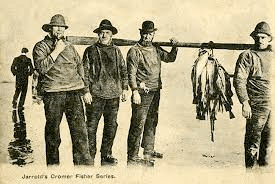
The above story has all the hallmarks of family legend. The most conspicuous being the lack of evidence for the drowning. I’ve recently been routing through ancestry websites, abusing all sorts of free trials, to try and piece it together. I have had some joy. Whereas, until this week, I couldn’t tell you precisely where or when the accident took place (other than ‘at sea’ and in ‘the olden times’), I can say that it happened in Cromer in 1919.
Until this week, also, I wasn’t even sure what the names of the people involved were: now I know that my great (x3) grandfather was John ‘Prushie’ Davies and his wife was Harriet Elizabeth Storey. Davies’ death report says he ‘drownd’ in 1919. That’s as far as I’ve got, however. The story still swills around in the distance of my conscience, a wishy-washy wisp of a thing.
The bones of ghost stories seldom have meat. Modern technology has done little to help matters. One might have thought that round-the-clock surveillance cameras and instant access to smartphones would have provided a bit more in the way of photographic evidence of the paranormal.
Instead, the more we see of ‘ghosts caught on camera’, the less convincing they become. Type ‘real ghosts’ into YouTube and the best you’ll get is green night-vision footage of an office chair rolling about in some depressing call-centre. The other videos involve things like devil children and messages written in blood; fabrications so influenced by Hollywood horror that they border on the insulting.
Apart from it being scientifically impossible, my main problem with the family fisherman story is that it is too cinematic. I could never be properly spooked by an anecdote so fully-formed. It’s so neat a tale that you can guess the ending halfway through. It doesn’t have a ring of truth to it, one of those unfathomable quirks that the truly frightening ghost stories have.
To give an example of something more satisfactorily chilling, here is a line from Peter Ackroyd’s collection of ‘true’ hauntings, The English Ghost. It is a three-year-old’s real description of an old man who haunted a family’s Windsor home:
‘He’s like Father Christmas,’ the boy said, ‘only he’s wearing burnt paper.’
Horrific.
I might not be able to offer anything as creepy as that, but I do have an unnerving story for you this Halloween. And, despite slagging off technology’s ability to capture spooks in the act, my ghostly encounter was, bizarrely, driven by technology.
It happened during Covid lockdown. The first lockdown, that is: the sunny lockdown with the bog-roll shortages, when people kept saying ‘the new normal’ and ‘now more than ever’. In that blue-sky springtime of working from home, I was teaching a one-to-one lesson online when, apropos of nothing, my pupil said this:
‘Sir. I swear I just saw a phantom standing behind you.’
‘Oh,’ I laughed. ‘Really?’
I tried to make light of the comment, whilst simultaneously probing the child for details I didn’t particularly want to hear. The ‘phantom’ (itself a far eerier word than ‘ghost’) had, the boy said, been standing over my shoulder, in front of my bookcase. It wore a blue jumper and had a big beard. It stood there, listlessly, then – and this is the worst part – walked backwards into the bookcase.
I think I made some joke about reporting the ghost for not social distancing. But, inwardly, I was on amber alert. For years I’d been loafing about in this one-bedroom flat and not once had I been aware of I had a lodger. The bastard never offers to chip in with the gas bill.
After finishing the lesson, I realised there was something I could do to prove whether the phantom sighting was genuine: the session, like all online school classes, had been recorded. Ah! I could play it back and see this ghoul for myself.
Let me tell you something, it’s one thing getting creeped out during a scary film, as the music slowly creeks and lurches, but it’s another to watch a horror movie in which you are the main star and the studio set is your lounge.
The video ticked along until it got to the key moment:
‘Sir. I swear I just saw a phantom standing behind you.’
Here’s the kick. Because the pupil was talking, the camera was on him, not me. My ghost, like all others in the long proud history of their ilk, had dodged the opportunity to appear on film.
The mystery remained. All I could do was laugh the incident off and assume, quite logically, that it was almost certainly a trick of the light or the latest malfunction of my Vodafone router. Such reasoning hasn’t done much to sedate my 3am visits to the loo – which, incidentally, involve a jaunt directly past the haunted bookcase – but it does at least make daytimes less frightening.
What made the boy’s sighting so convincing was that he wasn’t scared by the figure. It drifted in and out of his view without menace. He didn’t think the incident funny. It was reported as a matter of fact, as casually as if he had seen a postman at my window. The boy was, the more I think about it, the only person I know – or have ever known – who would not have lost their marbles after seeing such a thing. Later that term, a colleague tried to catch him out regarding the moment, but his story remained firm. It was a man in a blue jumper with a beard. And it walked backwards into my bookcase.
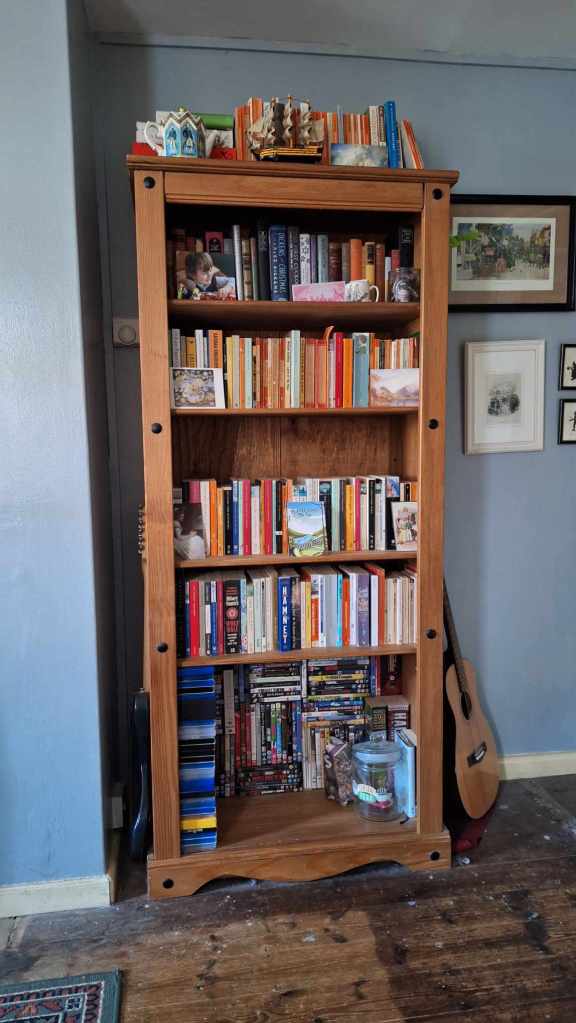
Three years later, as I sat at my computer, idling away, I felt compelled to get up and move an old leaving card that the pupil mentioned above had made for me. It was starting to bend at the corners, so I put it in a cupboard. As I walked back into the lounge, seconds later, past the bookcase, its top two shelves broke, sending their contents crashing to the floor. The pegs holding up the shelves had all snapped. It was so sudden that it felt as though they had been pulled down, almost in desperation. A heap of books lay pathetically on my floor.
I was so convinced that this was the work of the bearded bookcase loiterer that, as I picked the books from the floor, I grumpily looked up at the hollow space where the shelves had once been, and said, ‘Thanks for that, mate’.
It was only when later relaying this bizarre coincidence to friends that one of them said, ‘Woah – and did the boy’s leaving card mention the ghost?’
I hadn’t even thought about that.
I’m sure you can guess where this is going.
Here is what the card says:
‘I will never forget… when I saw what I thought to be a person behind you. I asked you, ‘is there anyone in the flat with you?’ And you said ‘No’, and I said, ‘Well then I think I just saw a ghost behind you!’ [He definitely said ‘phantom’ – which was presumably a more memorable word choice for me than for him] and you whirled around to see if there was anyone behind you, but there wasn’t. So you remained confused and worried. [I thought I’d acted calm and aloof!} And I remained convinced there was a ghost. I’m sorry if I may have terrified you out of your flat.’
There are enough qualifying words in the above passage to cast further doubt on the whole thing. But for those who think, as I can’t help but, that something odd was/is going on, let me tell you what I had been doing that April morning, just before putting the boy’s card in the cupboard, seconds prior to the bookcase violently shedding its load:
I had been googling the meaning of purgatory.
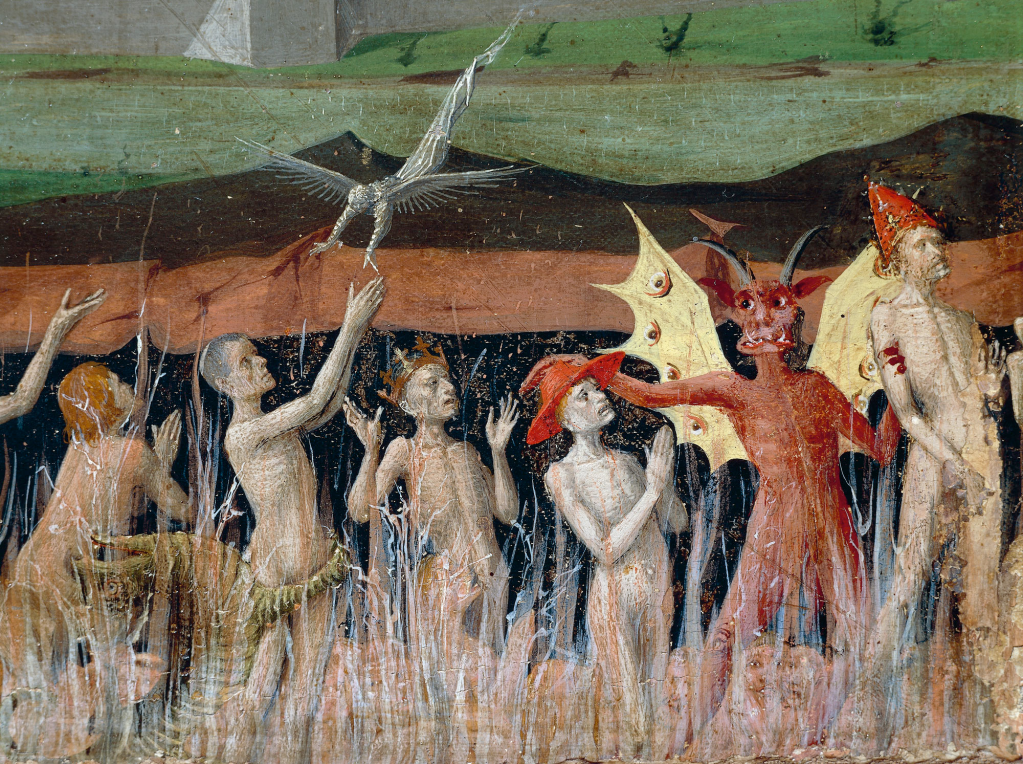
It is this final fact which haunts me most. I had no reason to be googling such a thing. Nothing triggered it. I just felt compelled to look it up. Purgatory. The Catholic notion of wandering souls, of those who die before having a chance to confess their sins.
Purgatory is neither heaven nor hell. Its inhabitants, allegedly, drift in and out of our world, waiting for the living to pray on their behalf and, by so doing, release them. The coincidence of the timing, of the shelves crashing down within seconds of the card being put away, ensured that my 3am lavatory trips were back to their 2020 levels of spookiness (luckily, this time, I had a mountain of loo roll).
Here is a conversation I had with my mum not long after the bookcase broke:
‘He lived near you, didn’t he?’
‘Who?’ I asked, somewhat concerned.
‘Your great grandad. The fisherman who drowned.’
‘Did he?!’ I replied, in an unduly shrill tone.
The bones of my ghost story suddenly had a little meat to them: the drowned fisherman from the top of the piece – with the big beard and blue jumper, who died out at sea without having had a chance to say his prayers and thereby avoid purgatory – lived in a little terrace house approximately thirty yards from my flat.
What was I supposed to do about it all?
Well, I did what I always do: I looked to the internet for answers. To my relief, my mum’s ability to grab sticks by the wrong end had held firm: it’s almost certain that John ‘Prushie’ Davies never lived in the same town as me. Unless his ghost fancied catching the bus for six miles, I think it’s safe to say it isn’t him who currently resides in my bookcase. Ancestry websites did, however, confirm that a fishing wing of my family did indeed live in a neighbouring house, as well as in various other dwellings very nearby. Those men, too, would almost certainly have had big beards and worn blue jumpers.
Might it be one of them who is paying me visits?
The incident with the bookcase has made me unduly/embarrassingly interested in Catholicism and ghosts. I’m not yet clutching rosary beads (I’m not even sure what they are) or going to spiritualist meetings in the function rooms of leisure centres, but I am now more intrigued in anything otherworldly.
I am a Christian, but I’ve never been one of those chirpy, hands-in-the-air, modern Christians who wear tight jeans and recommend books by funky New Hampshire pastors. I’m the dowdy sort who glances at his watch during prayer and smells a bit like a vestry. In truth, until the bookcase collapsed, my faith had been somnambulating. Now my ears have pricked up again. I have the sense of a hand on my shoulder, suggesting I return to the footpath. Am I to pray for the bearded bookcase fisherman’s passage to heaven – or had he come to guide me to mine?
A few years ago, whilst sat in a parked car on a rainy high street, my friend looked out towards the busy shops and said, ‘Sometimes I think all this is a facade, a trick to hide the spirit world’. I knew what she meant. It’s easy to mute the very concept of ghosts when you’re queuing up to buy a pair of slippers in Shoe Zone. Where once there were indiscernible shadows, there is now electric light. Bizarre smells are subdued by Glade Cherry Blossom Plug-Ins. Mysterious bumps in the night are muted by the One Show theme tune. We have tuned out of an old frequency.
The story about the bookcase is not a work of fiction. Nor can I guarantee it is fact. I can only guarantee that I am not lying. As I write this now, I am looking across at that very bookcase: at its orange-spined P.G. Wodehouse paperbacks; at its postcards of the Lake District and Lady Emma Hamilton; at the forgotten DVDs on the bottom shelf.
It is mundanity in its purest form.
Not once in its many years in my lounge has this item of furniture ever given the impression that it might also double up as a portal to Hades. But there we are. Perhaps like Shoe Zone, Glade Plug-Ins, and all our other distractions, its bookiness is just a facade, a trick to hide the spirit world. Father Christmas, without the burnt paper.
Merry Halloween!
 The Norfolk Writer