
Here’s the first thing I ask the staff when I enter a restaurant or tearoom or anywhere purporting to serve food:
‘Do you come to us or do we come to you?’
I ask it so often that it’s easy to ignore how odd the question is. It’s like leaning out of your bedroom window as the postie walks up the garden path and shouting, ‘Should I pop that letter through my door, mate, or were you planning to do it?’
Being our own serving staff is seemingly all part of the modern dining experience. We are taught to expect that, when eating out, there’s a fair chance we may have to do a hefty part of the waitering ourselves.
It’s only recently I’ve begun to question it; eating out is too expensive not to. We diners are fleeced at every turn, from the £7.95 bottle of Peroni to the £12.95 dollop of Tesco Value vanilla ice cream slapped onto a dead, powdered brownie. Considering our outlay, is a little subservience too much to ask? I don’t expect to have my brow mopped on arrival, but I do expect to not have to spend the evening being my own bus-boy.
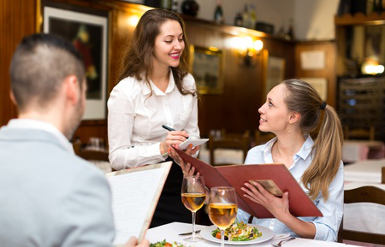
In fact, no, when I pay for a dining experience, I want everything done for me bar the chewing and the underwhelming conversation (those two things I can handle myself). Rather than having to collect the menu from a diseased wicker basket, I want it handed to me. Rather than jimmying my way through the throng at the bar, I want drinks brought to me. I want food brought to me. I want my knife and fork brought to me or, even better, for it to already be on the table when I arrive, rather than treated as an unexpected afterthought. I want to be asked if I’d like any condiments. And, when I say ‘yes’, I don’t want to be told ‘they’re over by the door, mate’ – I want those condiments brought to me.
There are too many establishments at which these modest requirements are not met. Wetherspoons being the most infamous. Eating at Wetherspoons is the closest an adult can get to recreating the school dinner experience without needing a PGCE. When you’re not picking your own cutlery out of a bucket, you’re wiping the salt sprinkles from the previous diners away from your table with a maroon napkin. I can’t imagine it will be long before Wetherspoons expect customers to help load the dishwasher.
Yet, it’s hard to voice complaint with Wetherspoons because it’s all so cheerfully cheap. Where else can you have a three-course meal, four pints, and buy everyone at the bar a chaser, but still leave the premises only £4.80 down? It’s genuinely more cost-effective than eating at home (especially now it costs the best part of a fiver just to turn your kitchen light on).
A sly propaganda has been at work over the last decade. It’s got nothing to do with Covid vaccinations or the New World Order. Instead, this propaganda has embedded a belief that there’s something charmingly rustic about restaurants offering customers a chance to be their own waiters. These days, even allegedly upmarket places are getting in on the self-serve act, offering all the legwork of a Wetherspoon’s meal at twenty times the cost.
The crisis has peaked with the introduction of pagers, those little black boxes which till staff give you to place on your table.
‘It’ll buzz when your food’s ready,’ they tell us. ‘Then you can come and collect it.’
Then you can come and collect it indeed.
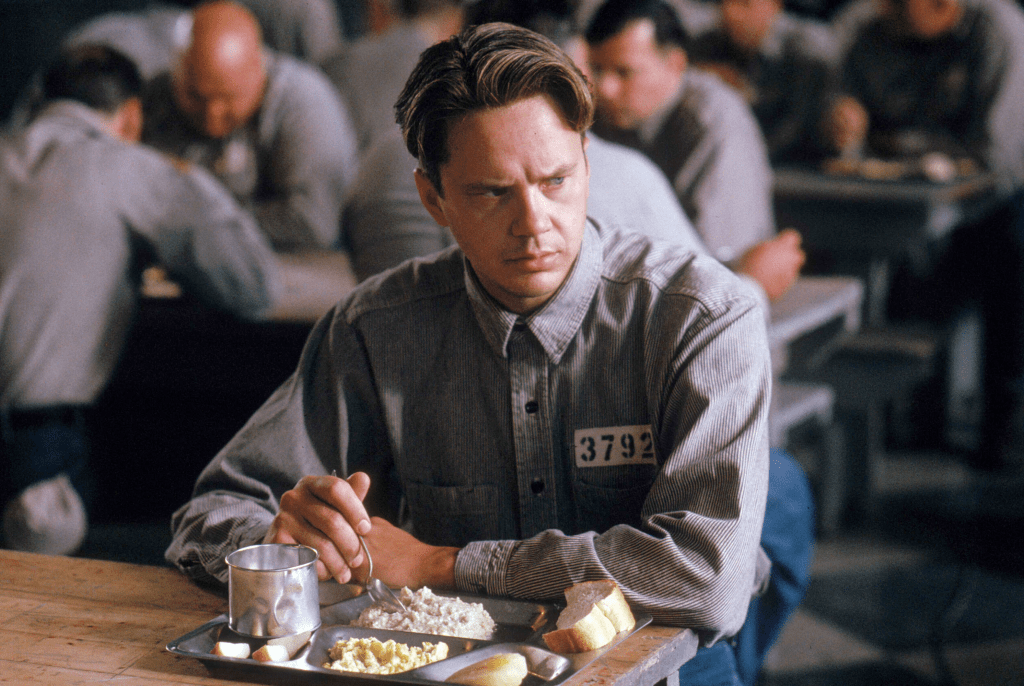
Why are restaurants operating the same self-serve policy as prison cafeterias?
I can’t find out where the pager system was invented, but it feels inherently like the work of a 21st-century Briton. Where once we designed steam locomotives to thrust society to exciting new landscapes, we now concoct miniature cattle prods to jolt us awake so we can go and collect our own nutrients. And, of course, rather than take insult upon being bequeathed this magical implement of labour, we instead marvel at it, and say, ‘Ooh, that’s clever’, then waddle back to our tables, pager in hand, content to be dabbling in modern trends.
Last summer, I went to one of Norfolk’s many fairy-lit vibe-fest eateries, the kind of place where you sit in a little wooden shack eating quadruple fried sweet potatoes from a tin bucket whilst fighting off a dying wasp. Before dinner had even been ordered, we noticed our table was coated in the sticky film of prior engagements. When I asked the bloke on the till if we could have it cleaned, he leapt into action:
‘Did you need one wet wipe or the whole packet, mate?’
Considering our small party made up about a third of their custom at that precise moment, a more innocent soul might have expected him to volunteer to come and clean the table for us. Or at least offer to help.
But then that wouldn’t be charmingly rustic.
Obviously, it was far too cool an establishment to have waiters. Instead, I was handed one of those black vibrating pagers mentioned above. I took it to our table (located in a hut somewhere out across ten miles of grassland). The moment I sat down, the pager shook with the ferocity of the San Andreas Fault circa 1906. Cue a back and forth across the grassland in which I racked up enough mileage to drop a jean size. There was a tip jar by the till. I was tempted to take a couple of quid from it on my way home.
At a similar establishment, a matter of miles further along the coast, a buff young go-getter with sailor tattoos made a point of walking to our table to tell us our hot chocolates were ready. He was one of three members of staff. We were the only customers.
‘Your hot chocolate’s done, guys,’ he said, then sauntered back.
I went to this cafe again last week (don’t ask why), and witnessed one of the four staff members lean out of the door to screech at one of the six customers in the courtyard:
‘STEPH?! STEPH?! HOT CHOCOLATE FOR STEPH! STEPH!’
Shaken from her reverie, Steph ambled up to collect her goods.

I have worked in restaurants. I do know the pain. I know that when somewhere is busy, the customer has to make adjustments to their expectations. But two expectations they should never have to adjust are, first, that their presence is welcome, and, second, that serving staff won’t be screeching their name across a quiet courtyard to tell them their hot chocolate is ready.
There might be some in the service industry who read this piece and arm themselves with defensive retorts about staffing issues, Covid, Brexit, and whatnot. But we all know this racket has been going on for years. Some restaurants are absolutely fantastic at making their customers feel wanted; others want their customers dead, ideally ASAP.
The long and short of it is, I want serving staff to pretend they think I’m a legend, even if they actually (and more accurately) think I’m a complete prick. A big part of that whole thinking-I’m-a-legend thing consists of bringing the food I’ve ordered to my table.
Part of me wonders if this makes me sound demanding. But then, another part of me wonders how it’s even got to a point where I’m daydreaming of being provided service by a service provider.
I don’t know if things are the same nationwide. But it’s all so much worse in where I am, in Norfolk, because meals out here often have a final devastating twist. A twist which I still fail to see coming every time:
‘We don’t take card payments, mate.’
‘Ah.’
‘There’s a cash machine just round the corner, though.’
And off one trots, glad to be of assistance.
 The Norfolk Writer